Definition of a Metal Shear
A metal shear, also referred to as a hydraulic shear, is a mechanical device designed for cutting metal materials. Utilizing a hydraulic drive system, this equipment cuts various types of metal scrap into regularly shaped pieces, facilitating subsequent processing and recycling. Due to its reliable safety performance and ease of operation, this machinery is widely used in metal recycling plants, end-of-life vehicle dismantling yards, and the smelting and casting industry. It serves as an essential auxiliary piece of equipment in the metal recycling process and in rolling mill operations.
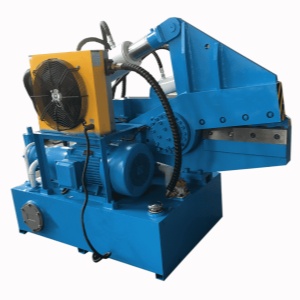
In terms of physical configuration, metal shears are primarily categorized into Gantry Shears, Alligator Shears, Tiger-Head Shears, and Box Shears, among which Alligator Shears and Gantry Shears are the most prevalent.
Structure of a Metal Shear
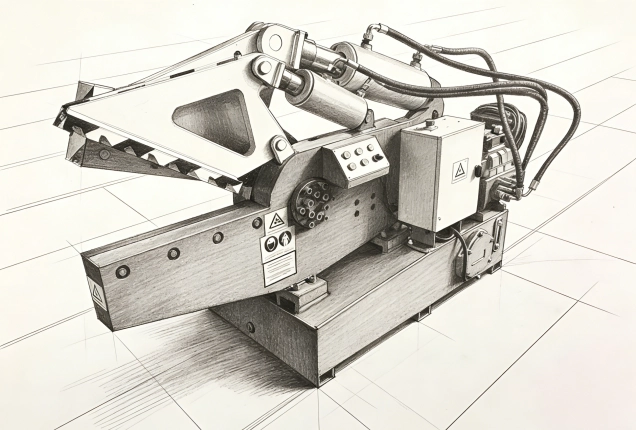
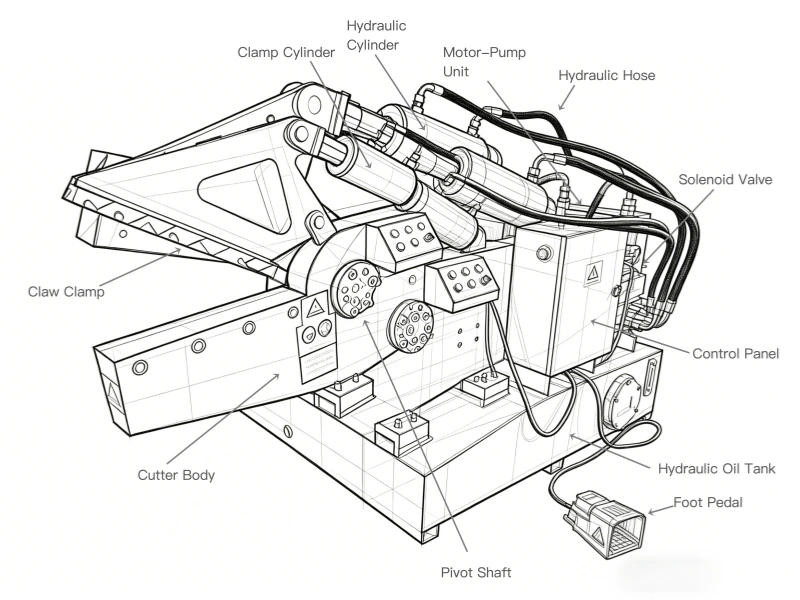
Taking the common Alligator Shear and Gantry Shear as examples, the main components are explained below.
A standard Alligator Shear typically consists of the following parts:
Cutter Body
The cutter body serves as the backbone and execution platform of the entire machine. To ensure safety, it is constructed as a welded framework of high-strength steel plates, supporting the hydraulic cylinders, blade seats, and transmission components. It must also withstand the immense counter-force generated instantaneously during the shearing process, thus forming the stable foundation of the equipment.
Pivot Shaft
The main shaft is the kinematic hub that connects and supports the blade holder. As the core transmission shaft, it ensures that the moving blade rotates smoothly around it during both the shearing and return strokes. Since the main shaft must simultaneously withstand the lateral pressure exerted during shearing, it also requires a high-strength design.
Hydraulic Oil Tank
The hydraulic oil tank primarily stores the hydraulic fluid and also serves the functions of cooling the return oil and allowing contaminants to settle.
Foot Pedal
The foot pedal is designed in accordance with operator working habits. Depressing the pedal triggers the shearing action, while releasing it initiates the return stroke and stops the cycle. This frees up the operator's hands, facilitating manual feeding of material.
Control Panel
The control box houses an integrated PLC, which is responsible for processing signals from push buttons, the foot pedal, and limit switches. It precisely controls the directional shifting of solenoid valves as well as the starting and stopping of the electric motor, enabling the switching between various shearing modes such as single-cycle and continuous operation.
Solenoid Valve
The solenoid valve shifts the position of its internal spool to change the direction of the oil circuit. This action controls the small clamping cylinder to first press down and secure the scrap metal, after which the main hydraulic cylinder executes the shearing stroke.
Electric Motor
The electric motor converts electrical energy into kinetic energy, driving the hydraulic pump to operate continuously. Its power rating determines both the shearing speed and the continuous operating capacity of the shear.
Hydraulic Pump
The hydraulic pump is driven by the electric motor. It pressurizes the hydraulic fluid drawn from the oil tank, continuously supplying power to the entire hydraulic system.
Hydraulic Cylinder
The hydraulic cylinder is the primary actuator responsible for executing the shearing action. High-pressure oil delivered from the hydraulic pump first drives the piston rod, which, utilizing the lever principle, actuates the moving blade holder to close. This generates immense shearing force to cut through the scrap metal.
Clamping Cylinder
The clamping cylinder serves to pre-compress and secure the scrap metal. Prior to the moving blade executing the shearing stroke, this small clamping cylinder extends first, driving the hold-down clamp to firmly secure the scrap metal against the lower blade seat. This prevents the material from ejecting or slipping during the cut, ensuring both operational safety and efficiency.
Claw Clamp
The hold-down clamp is the fixed pressure head that comes into direct contact with the scrap metal. Its structural design is capable of accommodating scrap metal of varying shapes, such as round bars and iron blocks. It is mounted at the end of the clamping cylinder and presses down on the material as the cylinder extends.
Components of a Gantry Shear
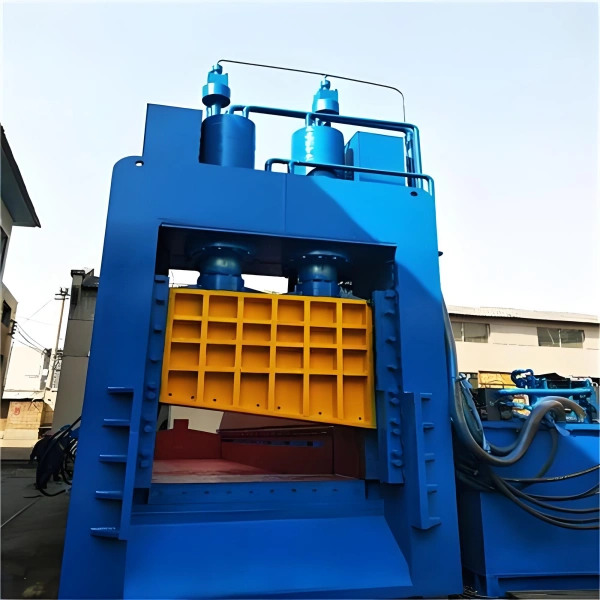
The working principle of a standard gantry shear is quite similar to that of an alligator shear; its appearance can be referenced in the image on the right. However, it differs slightly from the alligator shear in terms of specific components, as detailed below:
Charging Box (Hopper)
The charging box is the most distinctive external feature of a gantry shear. It is a large box-like structure, typically ranging from 6 to 8 meters in length, or even longer. Once the scrap metal is loaded into the charging box, a hydraulic ram at the rear pushes the material forward. According to the preset shearing frequency, the gantry shear can process large volumes of scrap in a single continuous operation.
Side Compression Cylinder
The side compression cylinder is responsible for pre-compacting the loose scrap metal within the charging box. It compresses the material from the side or from above to eliminate voids and secure the load. This ensures that the scrap is fed smoothly and consistently into the shearing station, thereby improving the efficiency of each shearing cycle.
Feeding Cylinder (Pusher Ram)
The feeding cylinder is located at the rear of the charging box and is driven by an independent hydraulic cylinder. Operated through the PLC control system, it can precisely control the distance the scrap material is advanced with each stroke, thereby enabling automated, continuous shearing operations.
V-Shaped Shear Blade Seat
The V-shaped blade seat prevents irregular scrap metal from rolling sideways during the shearing process. It also distributes the immense shearing force across multiple contact points, reducing single-point blade wear and minimizing the risk of blade chipping or fracture.