
How Does a Metal Briquetting Machine Work?
This article provides a detailed explanation of the working principle and process of the metal briquetting machine designed by TITAN. For a better understanding, you may first want to familiarize yourself with its structural components in: What Is a Metal Briquetting Machine?
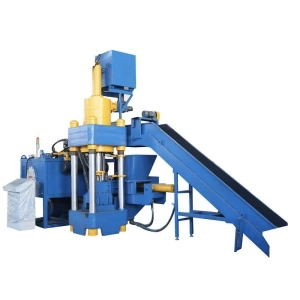
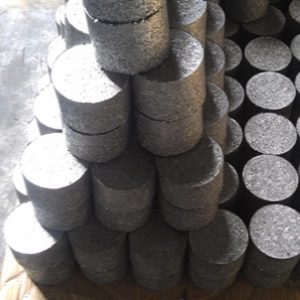
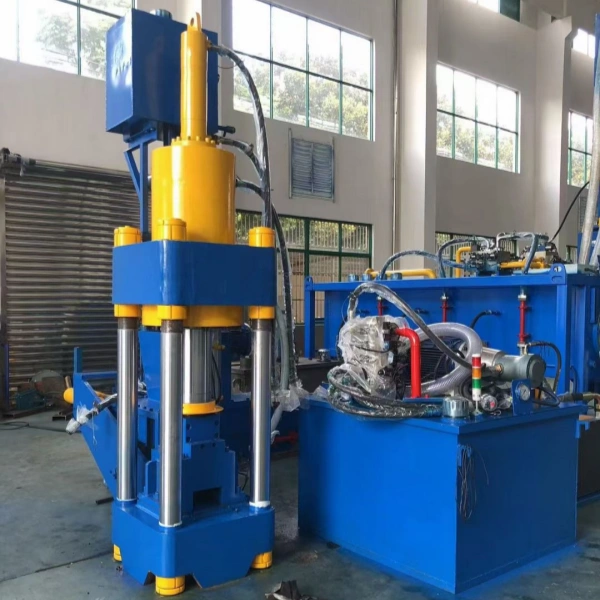
The working principle of a metal briquetting machine can be summarized as a highly integrated, efficient mechatronic-hydraulic process. Specifically, the machine uses an electric motor to drive the hydraulic system, generating immense pressure. The reciprocating motion of the hydraulic cylinder then pushes the ram, which subjects the fed metal chips—such as iron, aluminum, and copper turnings—to high-pressure compression. Confined within a sealed die, the loose chips are compacted into dense, uniformly shaped briquettes. The entire process features coordinated control across mechanical, electrical, and hydraulic systems, ensuring smooth and precise pressing action while significantly improving both the efficiency of metal scrap recovery and the quality of the finished briquettes.
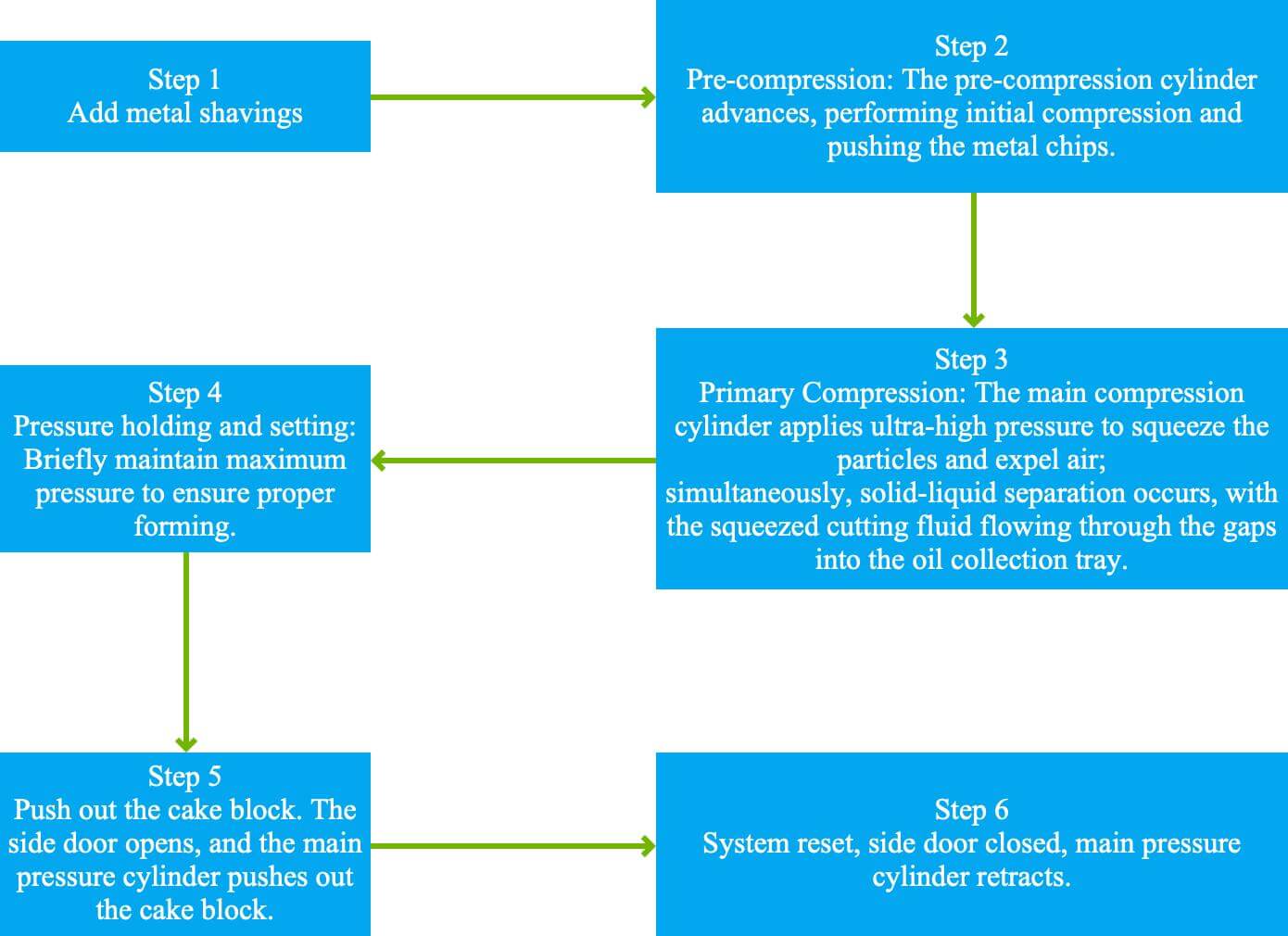
Its core cycle consists of an automated sequence: Pre-compression → Main Compression (including solid-liquid separation) → Pressure Holding → Ejection → Return. By perfectly integrating physical principles with engineering technology, the machine achieves volume reduction, densification, and resource recovery of waste metal scrap, making it an indispensable key piece of equipment in modern green manufacturing.
Taking the working cycle of a horizontal briquetting machine as an example, the operational steps can be roughly divided into the following five stages:
the operational steps
Feeding and Pre-compression
Based on our more than a decade of industry experience, operating a metal briquetting machine typically requires at least two personnel on site. Their primary task is shoveling scrap into the hopper. To boost efficiency, a feeding system can be installed to automatically and continuously convey waste metal chips into the hopper, though manual on-site assistance is still needed.
The metal chips enter the briquetting machine through the hopper. Once the preset amount is reached, the pre-compression cylinder (also known as the feeding cylinder) activates. Its piston rod advances, initially compressing the loose, tangled swarf inside the charging box and neatly pushing it into the main compression chamber (the die cavity). The purpose of this step is to force long, curly turnings into the cavity, preventing them from tangling or forming bridges, thereby preparing the material for the main compression stage and allowing the main cylinder to operate at maximum efficiency.
Main Compression and Solid-Liquid Separation
After the pre-compression cylinder retracts, the main cylinder activates immediately. Its massive piston rod—capable of generating tens or even hundreds of tonnes of force—drives the metal chips forcefully toward the end of the die cavity. In the initial stage, the chip particles shift and fill larger voids. As the pressure rises sharply, the chips first undergo elastic deformation, then reach their yield point and enter plastic deformation—the particles are stretched, bent, and interlock with one another. Some brittle chips or edges fracture, further filling microscopic gaps. The pressure causes the material to flow until all voids are eliminated to the greatest extent possible. At the same time, this immense pressure squeezes out the vast majority of the cutting fluid absorbed in the chips. The oil is forced out through meticulously designed fine slits in the die cavity wall, flows into the collection tray below, and is ultimately channeled into an oil drum for recovery. This is the critical stage at which the oil collection system operates.
Pressure Holding
Once the maximum pressure is reached, the system does not release it immediately. Instead, it holds this peak pressure for a set period of time—typically several seconds. This dwell allows the plastic deformation of the metallic material to fully complete, ensures that the expelled oil has sufficient time to drain away thoroughly, and guarantees the structural stability of the final briquette. It also prevents the briquette from expanding or cracking due to elastic springback, which would otherwise occur if the pressure were released instantaneously.
Briquette Ejection
Once the pressure holding phase ends, the main cylinder releases its pressure. The side door (or rear cover) of the die cavity is then driven open by a separate, smaller hydraulic cylinder—the side door cylinder. After this, the main cylinder advances again slowly, pushing the compacted, hardened briquette completely out of the die cavity. The briquette then falls under its own weight onto a transfer cart or conveyor belt positioned below. At this point, the briquette's temperature is slightly elevated due to the intense plastic deformation it has undergone.
Reset and Recirculation
After the briquette is ejected, the main cylinder's piston rod retracts fully to its initial position. The side door cylinder then actuates, closing and locking the side door to ensure a proper seal. With all components reset, the machine stands by, ready for the command to begin the next working cycle. The entire process is automatically controlled by a PLC (Programmable Logic Controller), enabling continuous cyclic operation without manual intervention.