
Peter Liu

Peter Liu

Chief Engineer · Engineering Profile

Chief Engineer at TITAN | Specializing in metal chip briquetting and engineering applications

Peter has worked in the metal recycling equipment industry for nearly 20 years, with metal chip briquetting as his primary field. Rather than selecting equipment from a single specification, he looks at how the material behaves in practice—its form, feeding behavior, fluid content and processing objective—and how those factors affect stable operation.

  • Core expertise: metal chip briquetting
  • Material condition assessment
  • Chips with oil or cutting fluid
  • Briquetting system configuration

About Peter Liu

Understand the Chips Before Choosing the Process

Peter Liu is TITAN’s Chief Engineer and has worked in the metal recycling equipment industry for nearly 20 years. His work has long centered on metal chip briquetting and its engineering applications. He also contributes to equipment selection and system configuration for scrap metal baling, shearing and shredding.

In briquetting projects, he looks beyond press force and rated processing capacity. The more important question is whether the material can be fed, compressed and formed reliably. Metal type, chip size and form, oil or cutting-fluid content, the degree of mixing and the actual chip generation rate all affect feeding, compression and continuous operation.

That is why Peter starts by asking what the material is, what condition it is in, and what the project actually needs to achieve: volume reduction, recovery of oil or cutting fluid, easier storage and transport, or a more consistent material form for downstream melting and reuse.

If direct briquetting is not appropriate, he considers whether the material needs pretreatment or whether baling, shearing or shredding is a better fit for the project objective.

Peter’s assessment does not begin with “Which machine is bigger?” It begins with material condition, site conditions and the customer’s actual processing objective.
Specialization

Metal Chip Briquetting Expertise

Rather than covering every type of scrap-processing equipment, Peter’s work has remained centered on metal chip briquetting. That experience has given him a practical understanding of how chip characteristics, briquetting equipment and real site conditions interact.

01

Metal Chip Condition Assessment

Assess whether short chips, fine chips, long stringy turnings or tangled chips will affect reliable feeding and briquette formation.

02

Fluid Content and Recovery Objectives

Assess how oil or cutting fluid content may affect briquetting, fluid separation and downstream processing objectives.

03

Matching Equipment to Site Conditions

Consider the actual chip generation rate, feeding method, available plant space and operating pattern together rather than comparing press force or model size in isolation.

04

Briquetting Applicability

Identify which materials can go directly to briquetting, which need pretreatment, and when another processing route is a better fit.

Related engineering experience: Peter also understands scrap metal baling, shearing and shredding. That broader process knowledge helps him decide when briquetting is appropriate—and when it is not—rather than forcing every scrap stream into the same type of equipment.

Engineering Approach

Assess the Conditions Before Choosing Equipment

On a metal chip briquetting project, Peter typically starts with the operating conditions rather than a specific machine model.

This is not a fixed “selection formula.” It is a way to understand the real operating conditions quickly, determine whether briquetting is appropriate, decide whether pretreatment is needed, and clarify what the equipment configuration needs to address first.

The basic logic is: Material → Condition → Generation Rate → Feeding → Processing Objective → Equipment Configuration.

01

What material is being processed?

Identify the metal and its source first; chip form and compression behavior can vary by material.

02

What condition is the material in?

Look at chip length, chip form, looseness, entanglement and whether materials are noticeably mixed.

03

Does it carry oil or cutting fluid?

Check whether the liquid content could affect operation and whether cutting-fluid recovery is part of the project objective.

04

How much is generated in practice?

Determine the required throughput based on actual shift patterns and the chip generation rate, rather than simply moving to a larger model.

05

How will the material be fed?

Manual feeding, lifting, conveying or in-line collection can directly affect the configuration of the overall system.

06

What does the customer need the process to achieve?

Volume reduction, fluid recovery, transport, preparation for melting or stable feeding set different engineering priorities.

Project Experience

Briquetting Experience Across Different Chip Conditions

The point is not the number of projects, but the range of real applications: different chip conditions and different processing objectives.

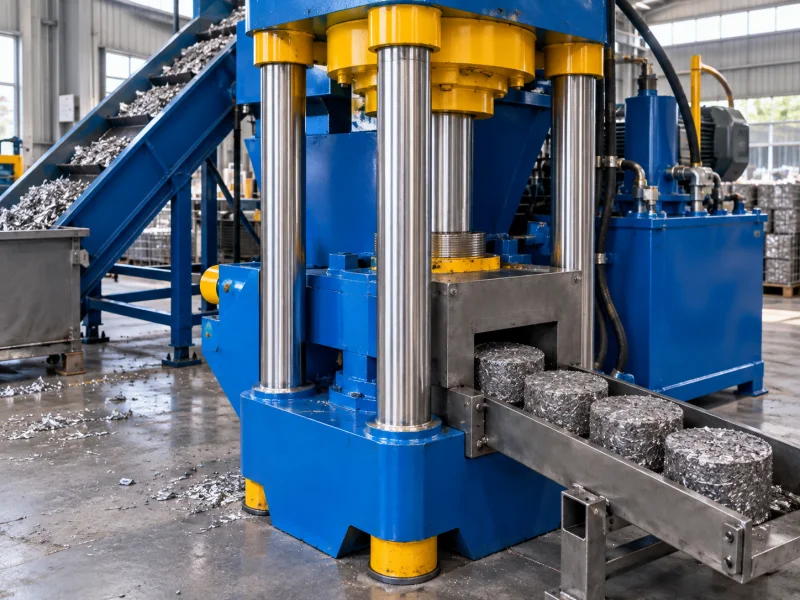
Uzbekistan | Aluminium Chip Briquetting & Oil Recovery

Uzbekistan · Aluminium chips

Uzbekistan | Aluminium Chip Briquetting & Oil Recovery

The briquetting route was configured around the fluid content of machining aluminum chips, the need for volume reduction and the objective of recovering cutting oil.

Engineering focus:Fluid-content assessment · Briquetting suitability · Fluid-recovery requirement
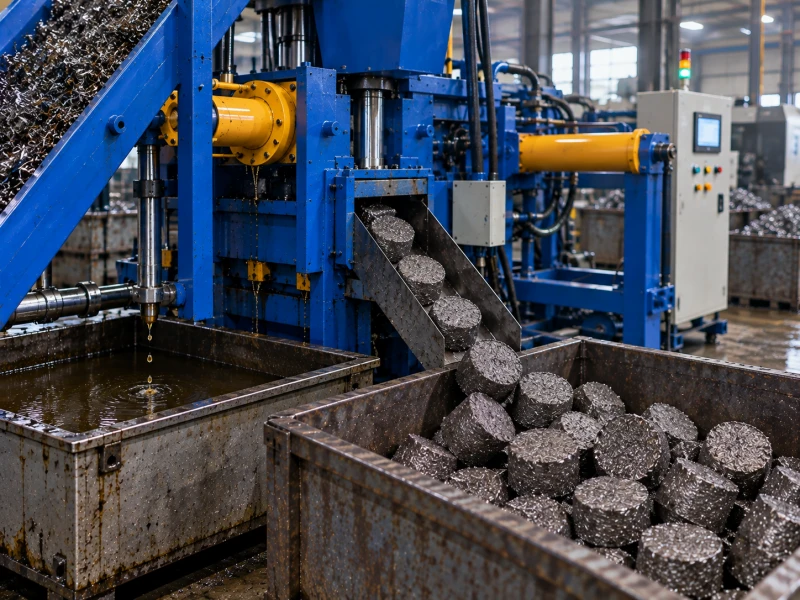
Russia | Oily Cast Iron Chip Briquetting Project

Russia · Grey cast iron chips, ductile iron chips

Russia | Oily Cast Iron Chip Briquetting Project

The equipment and site conditions were matched to the form of the cast iron chips, the need for continuous processing and the requirements for liquid collection.

Engineering focus:Handling cast iron chips · Continuous operation · Briquette formation and liquid collection
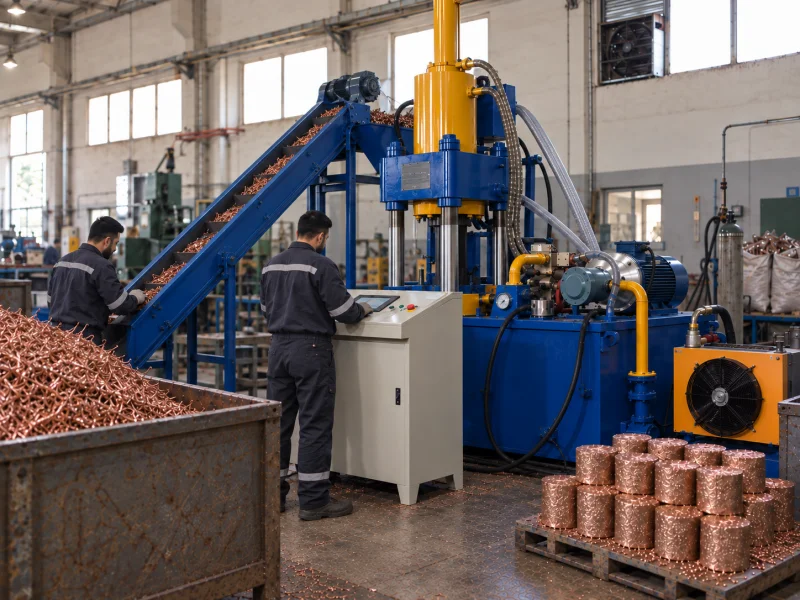
Algeria | Copper Chip Crushing & Briquetting Project

Algeria · Copper chips

Algeria | Copper Chip Crushing & Briquetting Project

The copper chips are first reduced to a suitable size before briquetting, with particular attention to maintaining stable feeding into the compression stage.

Engineering focus:Pretreatment assessment · Feed stability · Briquetting process configuration