What Factors Affect Metal Chip Briquette Density and Forming Quality?
Even when two batches of metal chips are both suitable for briquetting, the briquettes they produce may still be different.
Some briquettes are denser and maintain better integrity, with relatively consistent results from one cycle to the next. Others can still be formed, but may have lower density, show more noticeable springback or loosening after ejection from the die, or vary more significantly between batches.
These differences cannot simply be reduced to whether the machine provides “enough pressure.”
The final density and forming quality of a metal chip briquette are mainly determined by two groups of factors:
One is how the material itself responds to compaction;
The other is the actual pressing and forming conditions provided by the machine.
The key question is therefore not any single machine parameter, but whether:
The Condition of the Material Determines How Easily It Can Be Compacted
Different metals vary in hardness, ductility, and deformation behaviour. As a result, they do not compact in exactly the same way when subjected to the same external pressure.
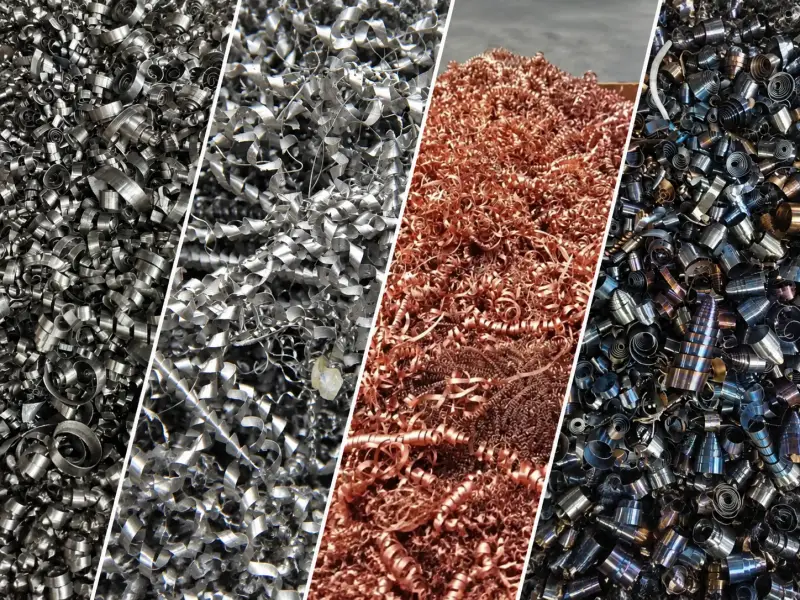
The physical form of the chips also affects this process.
Fine particles, short broken chips, and curled chips form different void structures in their loose state. After entering the die, these materials must first rearrange, move, and fill the available voids before undergoing further deformation and compaction.
This means that even metal chips of the same weight and material can begin compression from very different initial packing conditions if one batch is finer while another is more curled and bulky.
Liquid and contamination conditions can further change this compaction behaviour.
A certain amount of cutting fluid can be squeezed out during pressing. However, if the amount or distribution of attached liquid varies significantly between batches, the material may also behave differently during feeding, compression, and forming.
Likewise, if the amount and distribution of non-metallic contamination vary from batch to batch, the contact, void filling, and compaction behaviour between the metal chips can also change.
Unchanged machine settings therefore do not mean that every batch of feed material will produce exactly the same result.
The physical condition of the feedstock is itself an important variable affecting final briquette density and forming performance.
The Degree of Compaction Depends on More Than Machine Tonnage
Main pressing force is an important condition in the briquetting process, but by itself it does not represent the actual degree of compaction experienced by the material.
This is because the same force can create different compaction conditions when applied over different effective pressing areas.
In engineering terms, specific compaction pressure can be used to describe the pressing effect acting on each unit of effective pressing area of the material being compacted.
Main pressing force, specific compaction pressure, and hydraulic system working pressure describe different engineering quantities and should not be treated as interchangeable.
The main pressing force and the effective pressing area therefore need to be considered together when evaluating the degree of compaction.
The effective pressing area is also related to the die dimensions and the forming cross-section.
This means that even when two machines have the same rated main press force, differences in die dimensions, forming cross-section, or actual material condition can result in different compaction conditions.
It is therefore too simplistic to assume:
the higher the tonnage, the denser the briquette.
A more accurate relationship is:
For a more detailed explanation of the differences between main pressing force, specific compaction pressure, and hydraulic system working pressure, see “Core Technologies Behind Metal Chip Briquetting.”
Process Stability Determines Whether Briquettes Remain Consistent from Cycle to Cycle
Achieving sufficient compaction in a single briquette and consistently producing similar results across multiple cycles are not exactly the same thing.
In continuous briquetting, forming quality also depends on the stability of the entire pressing process.
For example, if the amount of material entering the compression area and its degree of looseness vary substantially from cycle to cycle, the initial condition before main compression will also be different.
Even if the main pressing mechanism ultimately reaches the same position or pressure, different initial filling conditions can still produce different briquette results.
Likewise, significant cycle-to-cycle variation in the condition after pre-compression, the main-compression endpoint, pressure holding, or decompression can affect the final integrity and consistency of the briquettes.
The briquetting process therefore needs to consider more than the “maximum pressure” it can reach. It also needs to consider:
Whether the material entering the die is relatively consistent from cycle to cycle;
Whether main compression reaches the intended compacted state;
Whether the target state can be maintained stably once reached;
Whether the high-pressure condition transitions smoothly into the briquette-ejection stage.
Together, these factors determine the repeatability of the briquetting process.
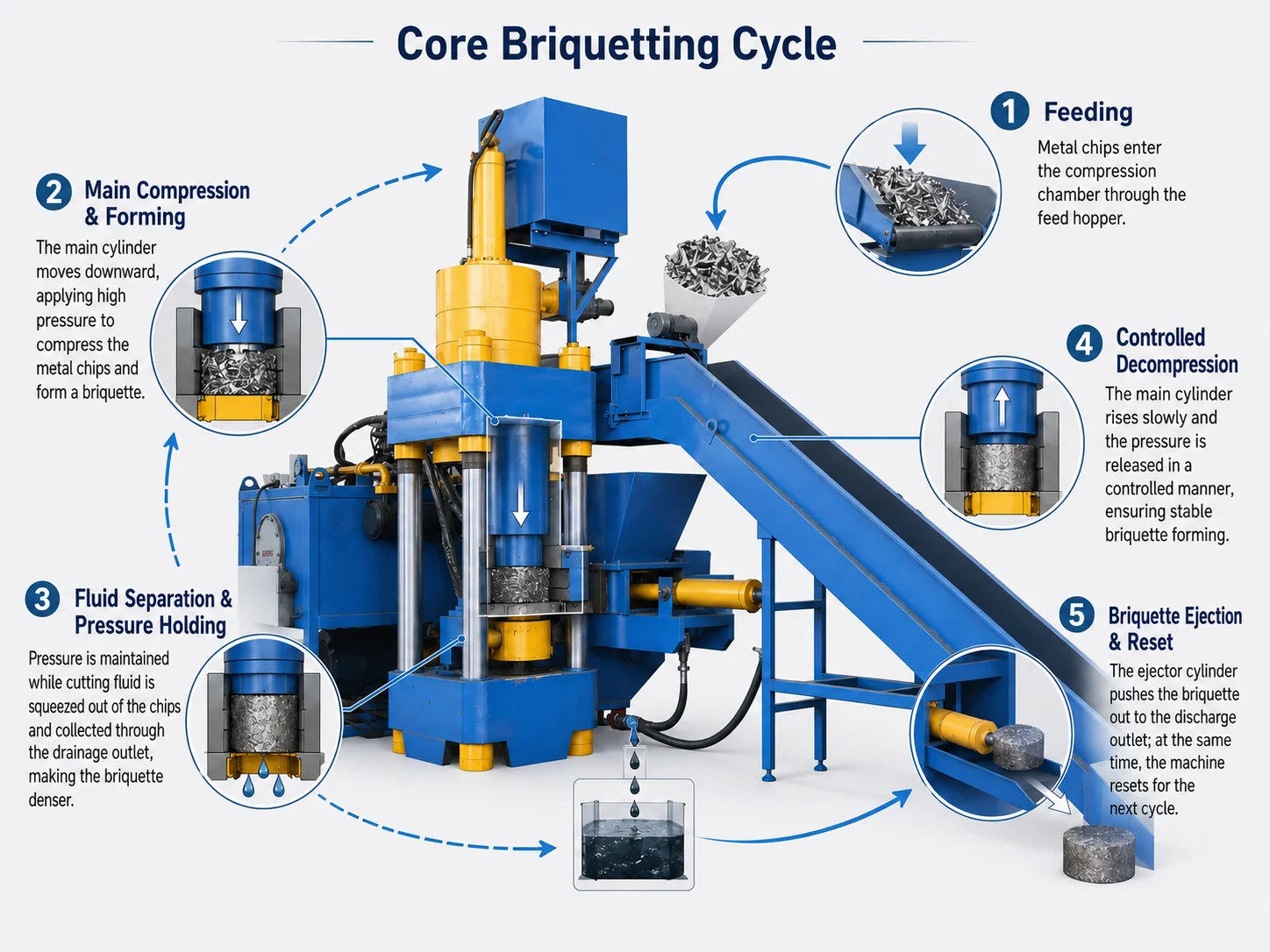
For the complete sequence of feeding, pre-compression, main compression, pressure holding, and briquette ejection, see “How Does a Metal Briquetting Machine Work?”
Stable Briquettes Come from Matching the Material Condition to the Pressing Conditions
Metal chip briquette density and forming quality cannot be assessed only from the machine side or only from the material side.
A more useful approach is to consider both together:
| Material Side | Pressing Side |
|---|---|
| Metal type and deformation characteristics | Actual compaction conditions |
| Chip form and initial packing condition | Main pressing force and effective pressing area |
| Liquid and contamination conditions | Die dimensions and constraint conditions |
| Batch-to-batch material consistency | Consistency of feeding, pre-compression, main compression, pressure holding, and decompression |
If the material condition changes significantly, the final briquette can change even when the machine settings remain unchanged.
Conversely, if the feed material is basically consistent but the feeding, pressing, or forming conditions change, briquette density and integrity can still fluctuate.
For this reason, simply increasing pressure does not necessarily solve a briquetting problem.
The first step is to determine whether the change originates on the material side or the pressing side.
Several different results also need to be distinguished:
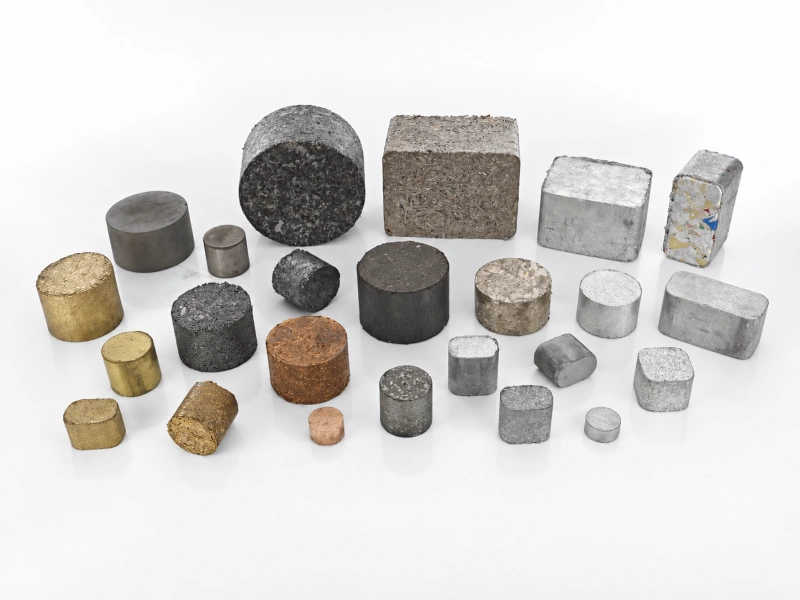
Describes the mass per unit volume of the briquette and reflects how far the material has been compacted.
Describes whether the briquette is likely to break, crumble, or undergo significant deformation during handling, conveying, or subsequent processing. In contexts where only the qualitative condition of the finished briquette is being assessed, this may also be described in terms of briquette integrity.
Describes whether multiple consecutive pressing cycles can produce similar and stable results. Therefore, higher briquette density and more stable forming are not exactly the same concept, and briquette density is not the same as briquette mechanical strength.
Continue Learning About Metal Chip Briquetting