How Does a Metal Briquetting Machine Work?
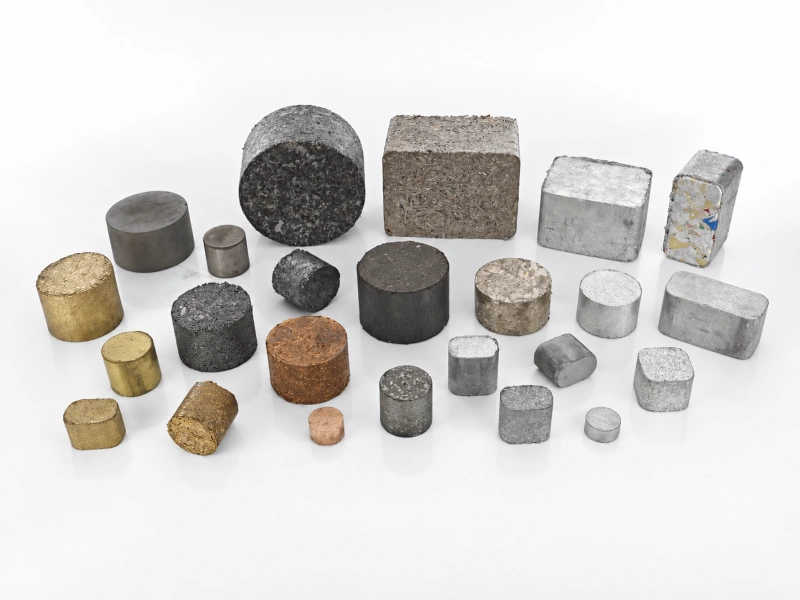
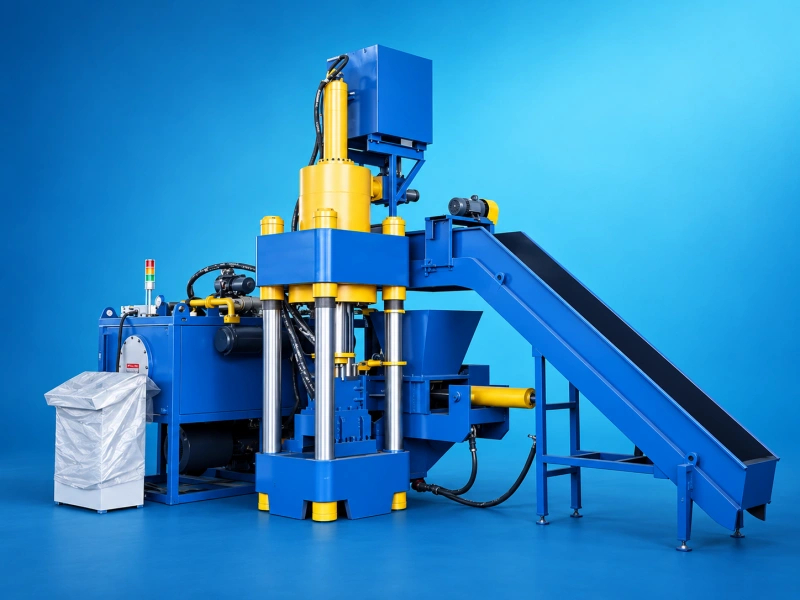
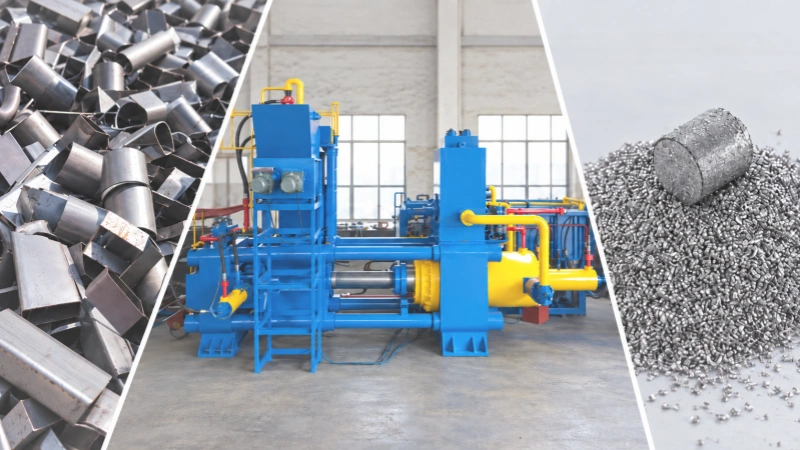
A Metal Briquetting Machine primarily uses a hydraulic system to generate pressing force. The system drives the press ram to compress metal chips inside the die cavity, progressively compacting the loose material and forming it into regular metal briquettes under the constraint of the die.
Viewed as a complete machine cycle, briquetting is not simply a matter of “pressing down” or “pushing forward” once. It is a sequence of coordinated actions carried out in a defined order.
For machines equipped with a pre-compression structure, a typical briquetting cycle can be summarized as:
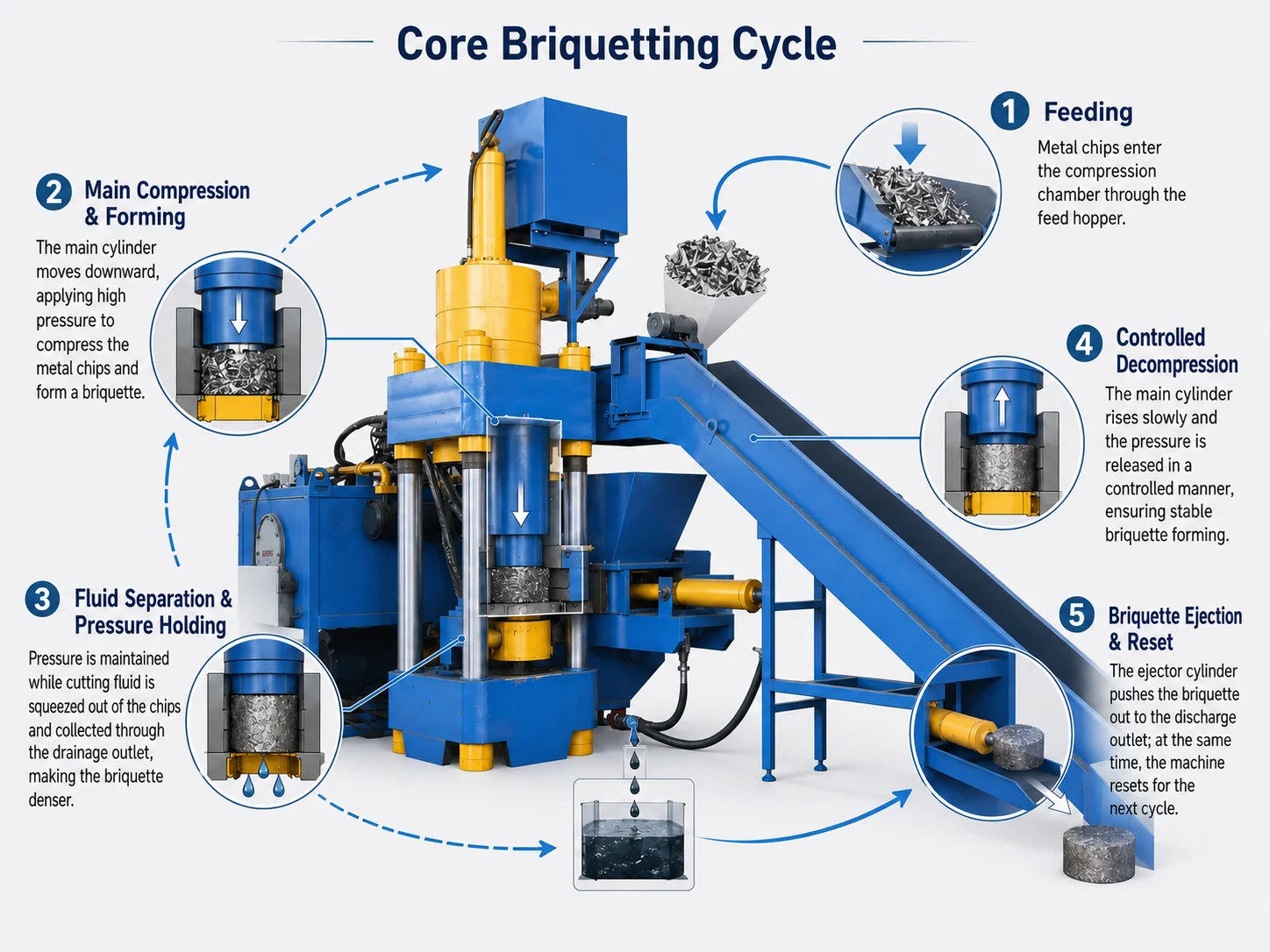
- 01Feeding
- 02Pre-compression
- 03Main Compression
- 04Pressure Holding
- 05Decompression
- 06Briquette Ejection
- 07Return to Home Position
The pre-compression action and specific structure vary by machine.
The specific feeding, pre-compression, liquid-drainage, and briquette-ejection arrangements can differ between machine designs. The sequence described here represents the general working logic of metal chip briquetting rather than an identical set of mechanical movements used by every machine.
For metal chips containing a certain amount of cutting or lubricating fluid, part of the liquid may also be squeezed out during compression and collected through a liquid-collection structure.
Understanding how a metal briquetter works, therefore, is not simply about how much pressure is applied. The key is to understand how the material enters the compression area and how the different hydraulic actions work together to complete one full briquetting cycle.
Feeding and Pre-compression: Establishing a Stable Material Condition for Main Compression
Metal chips first enter the machine through a hopper, conveying device, or another feeding method.
Loose metal chips contain large amounts of empty space, and their bulkiness and physical form can vary. In machines equipped with a pre-compression structure, the material is therefore initially compacted and conditioned after reaching the designated position.
The purpose of pre-compression is not to complete final forming. Instead, it further consolidates the loose material so that it enters the main compression area in a more stable condition.
Different metal briquetting press designs can use different feeding and pre-compression methods. Pre-compression therefore does not mean that every machine must use the same mechanical structure.
Main Compression: Volume Reduction and Forming Inside the Die Cavity
Once the main compression stage begins, the hydraulic system drives the main pressing mechanism, and the press ram continuously applies pressure to the metal chips inside the die cavity.
As the available compression space decreases, the voids between the loose chips are progressively reduced and the material is compacted into a denser state.
At the same time, the die cavity constrains the movement of the material, allowing the compacted metal chips to form a briquette with the specified cross-section and dimensions.
If the material contains a certain amount of cutting or lubricating fluid, part of the liquid is squeezed out from between the chips during compression and separated from the solid material through the drainage and liquid-collection structures provided in the compression area.
Pressure Holding and Decompression: Completing the Transition Between Pressing States
Once the machine reaches the set pressure or pressing position, it does not normally proceed immediately to briquette ejection. Instead, it maintains the current pressing state for a specified period.
This stage is known as pressure holding.
After the pressure-holding stage is complete, the system performs decompression, releasing the pressing pressure and allowing the machine to transition from the high-pressure pressing state to the briquette-ejection state.
The specific pressure-holding time and decompression process are not fixed values. They can be adjusted according to the machine structure, material condition, and control settings.
Pressure holding and decompression are therefore not additional actions separate from briquetting. They are integral stages of the complete pressing cycle.
Why pressure holding is required, why pressure release needs to be controlled, and how these processes affect briquette formation and hydraulic-system operation are discussed further in “Core Technologies Behind Metal Chip Briquetting.”
Briquette Ejection and Return to Home Position: Completing One Cycle and Preparing for the Next
After pressing is complete and the pressure has been released, the formed metal briquette is discharged from the die cavity.
Depending on the machine structure, the briquette can be ejected in different directions before entering a receiving device, conveying equipment, or a subsequent transfer stage.
Once briquette ejection is complete, the main pressing mechanism and other actuators return to their initial positions. The relevant discharge structures close again, and the machine returns to the state required for the next feeding cycle.
At this point, one complete briquetting cycle has been completed.
On machines using automatic control, control systems such as a PLC can coordinate the operating sequence, interlocks, and cycle control of the various mechanisms according to the programmed sequence. This allows feeding, compression, briquette ejection, and return movements to form a repeating production cycle.
Full Working Cycle of a Metal Briquetting Machine
Vertical and Horizontal Machines Move in Different Directions, but the Basic Principle Is the Same
Metal chip briquetting machines can use different structural configurations.
On vertical machines, the main pressing mechanism generally moves in the vertical direction. On horizontal machines, the main pressing mechanism operates horizontally and can be combined with different feeding and pre-compression arrangements.
The two configurations therefore differ in their direction of movement, feed arrangement, and machine layout.
Regardless of the structure used, however, the basic task remains the same:
Feed the metal chips into a confined compression space, use controlled pressure to compact and form the material, then discharge the formed briquette and begin the next cycle.
The structural differences between the two designs are not discussed further in this article. For a more detailed comparison, see “What Is the Difference Between Vertical and Horizontal Metal Chip Briquetting Machines?”
Once the complete briquetting cycle is understood, the next question is more fundamental: why can these coordinated actions reliably achieve compaction, forming, pressure holding, and decompression?
Answering that question requires a closer look at the core technologies behind metal chip briquetting.
Continue Learning About Metal Chip Briquetting