What Is the Difference Between Vertical and Horizontal Metal Chip Briquetting Machines?
A vertical metal chip briquetting machine and a horizontal metal chip briquetting machine follow the same basic briquetting principle: loose metal chips are fed into a compression area and compacted and formed under hydraulic pressure.
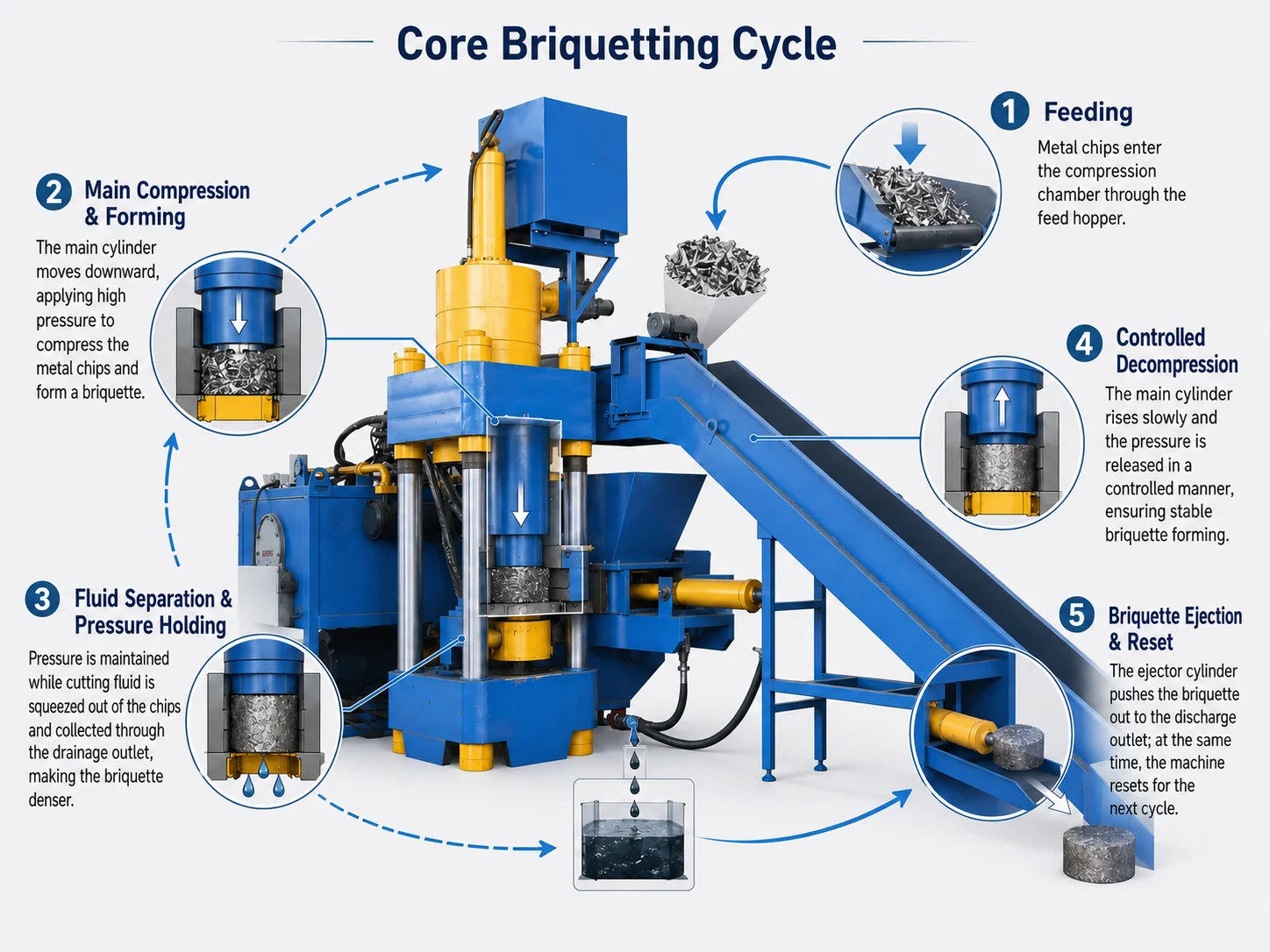
If you first need to understand the complete pressing cycle from feeding to briquette formation, see “How Does a Metal Briquetting Machine Work?”
The most obvious difference between the two is the orientation of the main pressing mechanism.
In a vertical configuration, the main pressing mechanism is arranged vertically. Material normally enters from the top of the machine, and the main press cylinder applies the pressing force downward.
In a horizontal configuration, the main pressing mechanism is arranged horizontally. After entering the feeding area, the material is transferred horizontally into the main compression chamber for pressing.
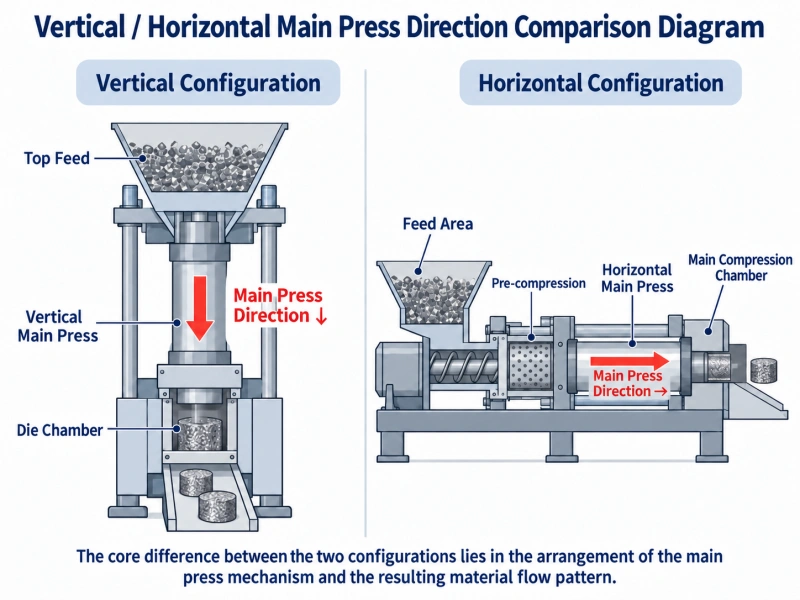
But describing the difference simply as “one presses vertically and the other horizontally” only captures the surface.
Once the main pressing direction changes, the overall machine layout, use of floor space, feeding arrangement, pre-compression structure, and approach to automation integration can also change.
Understanding the difference between vertical and horizontal configurations therefore requires looking beyond the external shape of the machine and considering how each design organises the complete path of the metal chips from feeding through forming.
Vertical Configuration: Organising Feeding and Compression Along the Vertical Axis
A vertical metal chip briquetting machine normally uses top feeding and vertical pressing.
Metal chips typically enter a hopper at the top of the machine before moving into the compression area below. The piston rod of the main press cylinder moves downward, pressing the material into the die cavity to form the briquette. After pressing is complete, the briquette is discharged through the lower part of the machine or the corresponding discharge structure.
Because the main pressing mechanism is arranged vertically, this design normally requires less horizontal floor space, although the overall machine height is usually greater.
This layout keeps the main machine structure relatively concentrated and allows the compression section to remain comparatively compact.
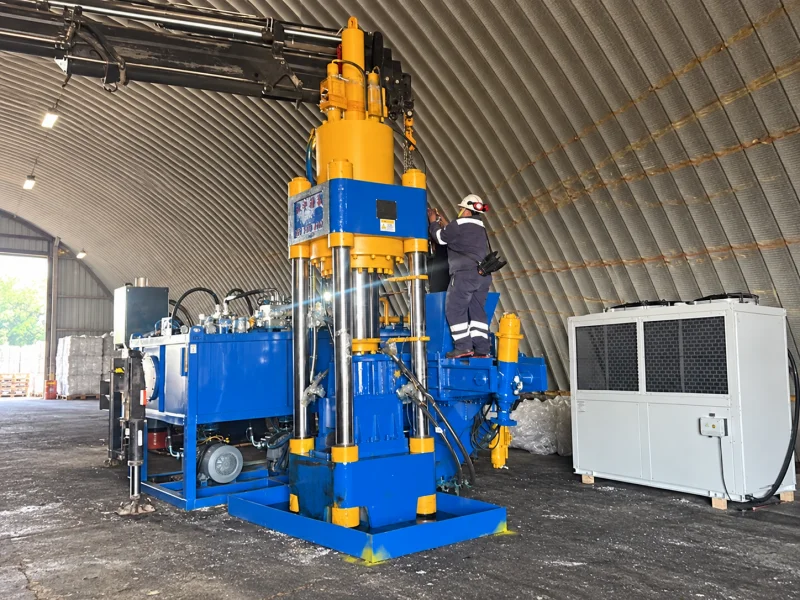
For feeding, a vertical machine may be loaded manually through the hopper, or lifting and conveying equipment may be added according to site requirements to deliver metal chips into the hopper.
For production environments where the feeding arrangement is relatively simple, this configuration can be straightforward to install.
However, the material still needs to move reliably from the upper hopper into the compression area.
If the metal chips are highly curled, tangled, or prone to bridging, reliable movement from the hopper into the compression area becomes particularly important.
This is essentially a question of whether the physical form of the metal chips is suitable for direct briquetting, so it is not discussed further in this section.
Horizontal Configuration: Organising Pre-compression, Main Compression, and Continuous Feeding Along the Horizontal Axis
A horizontal metal chip briquetting machine arranges its main pressing mechanism horizontally.
Material can still enter through a hopper, but once it has entered the hopper, the feeding and compression path differs from that of the vertical configuration.
Based on TITAN's technical knowledge of horizontal equipment, a typical arrangement uses pre-compression and main compression in coordination.
After the metal chips enter the feeding area, the pre-compression mechanism first organises and initially compacts the loose material before feeding it into the main compression chamber. The main pressing mechanism then completes the final high-pressure pressing in the horizontal direction.
A horizontal configuration is therefore not simply a vertical machine “turned on its side”.
It can use a longer horizontal layout to organise feeding, pre-compression, main compression, and briquette discharge along a continuous material-flow direction.
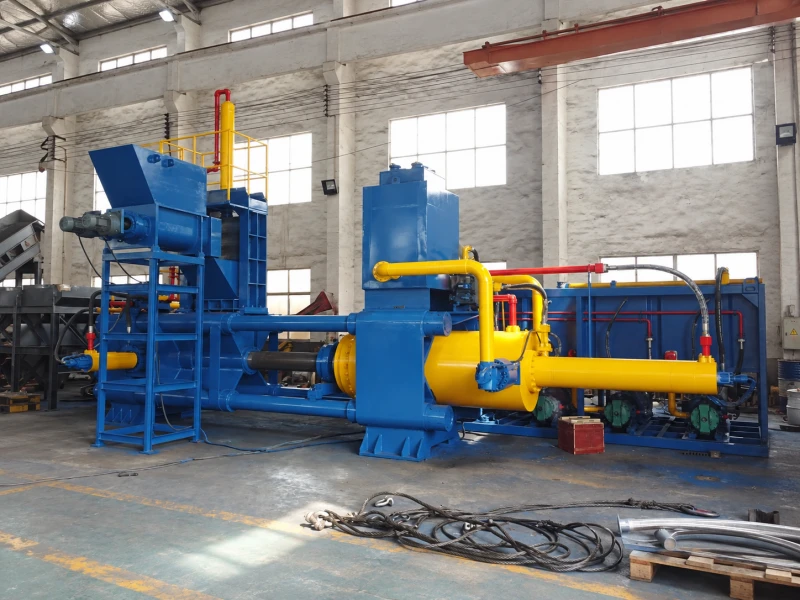
For more detail on why pre-compression, die constraint, pressure holding, and hydraulic control affect the briquetting process, see “Core Technologies Behind Metal Chip Briquetting.”
With the appropriate supporting design, a horizontal machine can also be connected more readily with hoppers, conveying equipment, pretreatment equipment, and discharge conveyors to form a continuous scrap-processing system.
Correspondingly, it generally requires more horizontal installation space, while its internal actuators and control sequence are also more complex.
Main Differences Between Vertical and Horizontal Configurations
When the two configurations are compared directly, the main differences can be summarised as follows:
This table describes the general differences between the two configurations. It does not mean that one is inherently better than the other.
Vertical and horizontal machines are first of all two different mechanical layouts.
Only when the machine structure is considered together with the actual material condition, production rhythm, and site conditions do these structural differences translate into practical operating differences.
| Comparison | Vertical Metal Chip Briquetting Machine | Horizontal Metal Chip Briquetting Machine |
|---|---|---|
| Main pressing direction | Vertical | Horizontal |
| Feeding arrangement | Normally enters the compression area through an upper hopper; manual loading, lifting, or conveying can be used | Normally enters the feeding area through a hopper and can then be transferred into the main compression chamber through a pre-compression mechanism |
| Compression structure | Main pressing mechanism is relatively concentrated | Can use coordinated pre-compression and main-compression structures |
| Space characteristics | Relatively small horizontal footprint, but greater machine height | Larger horizontal footprint; plant-height requirements are generally easier to accommodate |
| Feeding organisation | Suitable for relatively concentrated and direct feeding arrangements | Easier to organise continuous feeding |
| Automation integration | Can use automatic control and can also connect to external feeding equipment | Easier to integrate with conveying, pretreatment, and discharge equipment as a continuous system |
| Structural complexity | Relatively simple and compact | More complex actuator arrangement and system organisation |
| Maintenance characteristics | Concentrated structure makes maintenance relatively direct | More components and actuating mechanisms generally mean higher maintenance requirements |
The Real Effect of the Structural Difference Is How the Machine Fits into the Production Process
The most important distinction between vertical and horizontal metal chip briquetting machines is not simply the direction in which the press ram moves.
Changing the pressing direction also changes how the machine receives material, uses plant space, and connects with upstream and downstream equipment.
If briquetting is a relatively independent process at the site, with metal chips collected first and then delivered to the machine in batches, and the machine mainly needs to handle feeding, pressing, and briquette discharge, a vertical configuration can complete the process within a relatively concentrated mechanical layout.
If the production site requires metal chips to enter the briquetting stage continuously and the machine needs to connect further with conveying, pretreatment, liquid-collection, or automatic discharge equipment, a horizontal configuration provides more room for organising the process as a horizontal production line.
The structural difference can therefore be understood as follows:
A vertical configuration organises feeding and pressing more compactly along the vertical axis;
A horizontal configuration provides more room to organise feeding, pre-compression, main compression, and continuous conveying along the horizontal axis.
Machine structure, however, is only one part of the actual assessment.
Before deciding between a vertical or horizontal configuration, the more fundamental question remains whether the material type, physical form, liquid content, and contamination of the metal chips are already suitable for briquetting.
For more detail on when different chip conditions are ready for direct briquetting and when pretreatment may be required, see “Which Metal Chips Are Suitable for Briquetting?”
A machine therefore should not be judged suitable for a particular type of metal chip solely because it is described as “vertical” or “horizontal”.
Machine configuration needs to be matched together with material condition, processing capacity, available site space, and automation requirements.
Structural Selection Should Consider All Four
Continue Learning About Metal Chip Briquetting